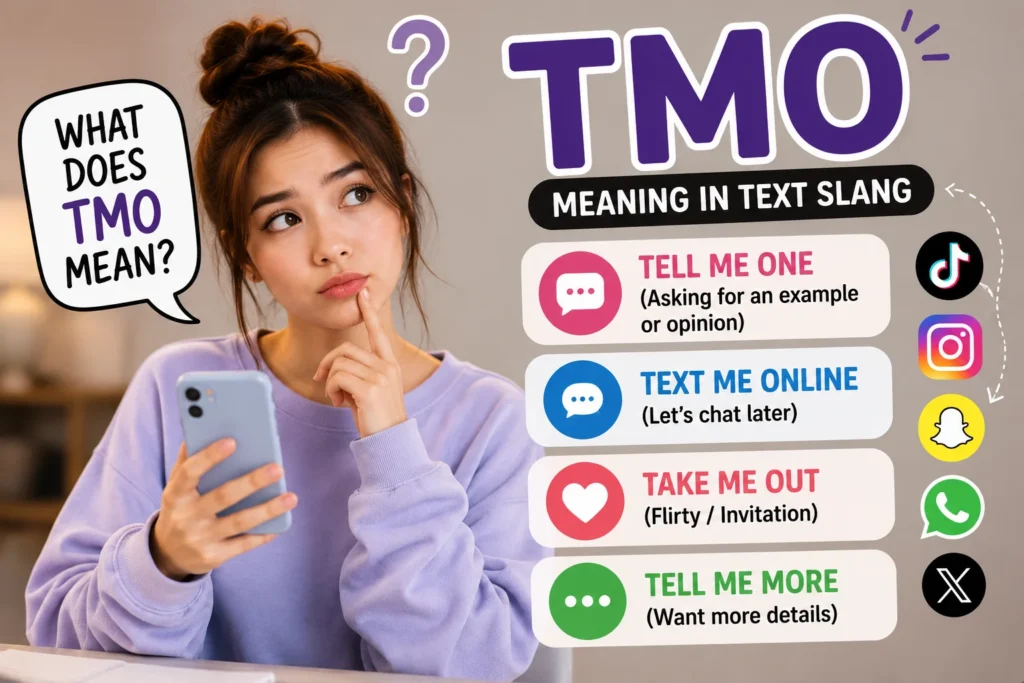

TMO in text slang most commonly means “Tell Me One,” “Text Me Online,” or “Take Me Out,” depending on the conversation. People search for TMO because the abbreviation has multiple meanings across texting, Snapchat, TikTok, Instagram, and online chats, making it easy to misunderstand.
If someone sends you “TMO,” the meaning depends entirely on context. In casual texting, it often serves as a request for information, an invitation, or a conversational prompt. Unlike abbreviations such as LOL or BRB, TMO does not have one universally accepted definition, which is why many people look it up after seeing it in a message.
What Does TMO Mean in Text Slang?
The most common meanings of TMO include:
| TMO Meaning | Context | Popularity |
|---|---|---|
| Tell Me One | Asking for an example or opinion | High |
| Text Me Online | Requesting a message later | Medium |
| Take Me Out | Flirty or social conversations | Medium |
| Tell Me More | Sometimes used informally | Lower |
Unlike fixed acronyms, TMO changes meaning depending on who is using it and where it appears.
Tell Me One
This is one of the most common interpretations.
Example:
A: What’s your favorite movie?
B: TMO that always makes you laugh.
In this context, TMO means “Tell Me One.”
Text Me Online
Used when someone wants to continue a conversation later.
Example:
A: I have to leave now.
B: No problem, TMO when you’re free.
Take Me Out
A playful or flirty meaning.
Example:
A: You keep talking about that restaurant.
B: Then TMO sometime.
Here it means “Take Me Out.”
Tell Me More
Occasionally, TMO is used as shorthand for “Tell Me More.”
Example:
A: I met a celebrity today.
B: TMO!
Is TMO an Acronym, Abbreviation, or Slang?
TMO is primarily an acronym abbreviation used in informal digital communication.
Acronym
The letters represent a longer phrase.
Examples:
- Tell Me One
- Take Me Out
- Text Me Online
Slang Usage
Over time, TMO has become texting slang because users often understand its meaning without writing the full phrase.
Formality Level
TMO is considered highly informal and is rarely appropriate in professional communication.
TMO Meanings by Platform
TMO on TikTok
On TikTok, TMO usually appears in comments.
Examples:
- “TMO your favorite song.”
- “TMO why everyone loves this trend.”
The meaning is typically “Tell Me One” or “Tell Me More.”
TMO on Instagram
Instagram users often use TMO in Stories and DMs.
Examples:
- “TMO your biggest travel goal.”
- “TMO if you’ve watched this show.”
TMO on Snapchat
Snapchat conversations commonly use abbreviations to save time.
Examples:
- “TMO when you’re awake.”
- “TMO what happened.”
TMO on WhatsApp
WhatsApp users may use TMO in casual group chats.
Examples:
- “TMO a good restaurant nearby.”
- “TMO what the teacher said.”
TMO on X
On X (formerly Twitter), TMO appears less frequently but may be used in replies.
Examples:
- “TMO why this game is trending.”
- “TMO your prediction.”
Tone and Context Variations
Funny Tone
A: I just ate an entire pizza.
B: Alone?
A: Yep.
B: TMO your secret powers.
Sarcastic Tone
A: I forgot my homework again.
B: Wow, shocking.
A: You’re not surprised?
B: TMO something new.
Playful Tone
A: I found the cutest café.
B: Really?
A: You’d love it.
B: Then TMO sometime.
Serious Tone
A: I’ve been thinking about changing careers.
B: That’s a big decision.
A: I’m not sure what to do.
B: TMO what’s making you consider it.
Real Chat Examples
Example 1
A: What’s your favorite vacation spot?
B: TMO yours first.
A: Italy.
B: Mine is Japan.
Example 2
A: I missed the meeting.
B: TMO what happened.
A: My internet went down.
B: That explains it.
Example 3
A: Have you seen the new movie?
B: Not yet.
A: It’s amazing.
B: TMO the best part.
Example 4
A: I finally got promoted.
B: That’s awesome.
A: I’m excited.
B: TMO how you celebrated.
Example 5
A: I’m bored.
B: Same.
A: Any ideas?
B: TMO a fun activity.
Example 6
A: Guess what happened today.
B: What?
A: I met my favorite athlete.
B: TMO everything.
Example 7
A: I found a hidden beach.
B: Seriously?
A: It was beautiful.
B: TMO where it is.
Example 8
A: I need a new TV series.
B: TMO what genres you like.
A: Mostly mystery.
B: I have several recommendations.
Example 9
A: I’m thinking about learning guitar.
B: Great idea.
A: Any tips?
B: TMO your music taste first.
Example 10
A: I got concert tickets.
B: Nice!
A: Front row seats.
B: TMO you’re bringing me.
Example 11
A: I discovered a new coffee shop.
B: Is it good?
A: Amazing.
B: TMO next weekend.
Grammar and Language Role
Part of Speech
TMO functions as an abbreviation rather than a traditional part of speech.
Sentence Position
Most commonly found:
- At the beginning of a sentence
- As a standalone response
- At the end of a message
Examples:
- TMO your favorite movie.
- I need advice, TMO.
- TMO!
Can It Replace a Full Sentence?
Yes.
Instead of saying:
“Tell me more about that.”
Someone may simply write:
“TMO.”
Formal vs Informal Register
| Context | Appropriate? |
|---|---|
| Text Messages | Yes |
| Snapchat | Yes |
| Instagram DMs | Yes |
| Workplace Emails | No |
| Academic Writing | No |
| Business Reports | No |
How to Reply to TMO
Your response depends on the meaning being used.
Funny Reply
“TMO? Only if you’re ready for a five-hour story.”
Serious Reply
“Sure, here’s what happened.”
Flirty Reply
“If you’re asking me to take you out, I might consider it.”
Neutral Reply
“What would you like to know?”
TMO vs Similar Slang Terms
| Term | Meaning | Usage Context | Tone | Popularity | Confusion Risk |
|---|---|---|---|---|---|
| TMO | Tell Me One / Take Me Out | Texting & social media | Varies | Medium | High |
| IMO | In My Opinion | Opinions | Neutral | High | Low |
| IDK | I Don’t Know | Casual replies | Neutral | Very High | Low |
| TBH | To Be Honest | Honest statements | Neutral | High | Low |
| HMU | Hit Me Up | Contact me | Friendly | High | Medium |
| NVM | Never Mind | Dropping a topic | Opposite direction | High | Low |
Who Uses This Term?
Age Group Breakdown
| Age Group | Usage Level |
|---|---|
| 13–17 | High |
| 18–24 | Very High |
| 25–34 | Moderate |
| 35+ | Lower |
Gen Z vs Millennials
Gen Z
Gen Z frequently uses abbreviations like TMO because they prioritize fast communication.
Millennials
Millennials may recognize TMO but generally use more established abbreviations such as LOL, BRB, or IMO.
Regional Usage
TMO is not tied to one country.
It appears in:
- United States
- United Kingdom
- Canada
- Australia
- Other English-speaking online communities
Platform Preferences
| Platform | Common Meaning |
|---|---|
| TikTok | Tell Me One |
| Tell Me One | |
| Snapchat | Text Me Online |
| Tell Me One | |
| X | Tell Me More |
Origin and Internet Culture
Where Did TMO Come From?
TMO emerged from the broader culture of text-message abbreviations.
As mobile keyboards and SMS character limits encouraged shorter messages, users began reducing common phrases to initials.
Internet Evolution
Like many acronyms, TMO spread through:
- Online forums
- Messaging apps
- Gaming communities
- Social media platforms
TikTok’s Influence
TikTok has helped expose newer audiences to abbreviations like TMO.
Users often place it in comments to encourage conversation or request additional information.
Cultural Development
Unlike slang with clear cultural origins, TMO developed organically from convenience-based communication.
It is not generally associated with AAVE or any specific cultural group.
Safety and Appropriateness
Is TMO Offensive?
No.
TMO itself is not offensive.
Does It Contain Profanity?
No.
The abbreviation contains no profanity.
Is It Safe for School?
Generally yes.
Teachers may still prefer complete words in academic work.
Is It Appropriate for Work?
Usually not.
Professional communication should avoid ambiguous abbreviations.
Cultural Sensitivity Notes
TMO has no major cultural or social sensitivity concerns.
The primary risk is misunderstanding the intended meaning.
Real-World Observation
One reason abbreviations like TMO survive online is that they allow people to communicate quickly while creating a sense of insider knowledge. People who regularly use Snapchat, TikTok, or Instagram often understand these shortcuts immediately, while others may need context to decode them. The abbreviation’s flexibility is both its strength and its weakness—it saves time, but it can also create confusion because multiple meanings exist simultaneously.
Frequently Asked Questions
What does TMO mean in texting?
Most commonly, TMO means “Tell Me One,” “Tell Me More,” or “Take Me Out.” The correct meaning depends on the conversation and the relationship between the people chatting. Looking at the surrounding messages usually reveals which interpretation fits.
What does TMO mean on Snapchat?
On Snapchat, TMO often means “Text Me Online” or “Tell Me One.” Users commonly employ it when asking someone to continue a conversation later or provide an example.
Is TMO a slang word?
TMO is technically an acronym abbreviation. However, because it is widely used in informal online conversations, many people consider it part of internet slang.
What does TMO mean on TikTok?
On TikTok, TMO is frequently used in comments requesting information or opinions. In most cases, it stands for “Tell Me One” or “Tell Me More.”
Is TMO rude?
No. TMO is generally neutral. The tone depends entirely on how it is used and the context of the conversation.
Can TMO mean Take Me Out?
Yes. In some flirty or social situations, TMO can mean “Take Me Out.” This meaning is less common than informational uses but still appears in texting conversations.
Why does TMO have multiple meanings?
Many internet abbreviations evolve naturally across different online communities. As different groups adopt them, new meanings develop while older meanings continue to exist.
Should I use TMO in professional communication?
Generally no. Because TMO has several possible interpretations, writing out the full phrase is usually clearer and more professional.
Conclusion
TMO is a flexible texting abbreviation that most commonly means “Tell Me One,” “Tell Me More,” “Text Me Online,” or “Take Me Out.” The intended meaning depends heavily on context, platform, and relationship.
Usage Tips
- Read the surrounding messages for context.
- Assume the most common meaning first.
- Use it mainly in casual conversations.
- Clarify if the meaning seems unclear.
Common Mistakes
- Assuming every TMO means the same thing.
- Using it in professional emails.
- Ignoring conversational context.
- Treating it as a universally recognized acronym.
When to Use It
- Casual texting
- Social media comments
- Group chats
- Friendly conversations
When to Avoid It
- Formal workplace communication
- Academic writing
- Legal or official documents
- Situations where clarity is critical