
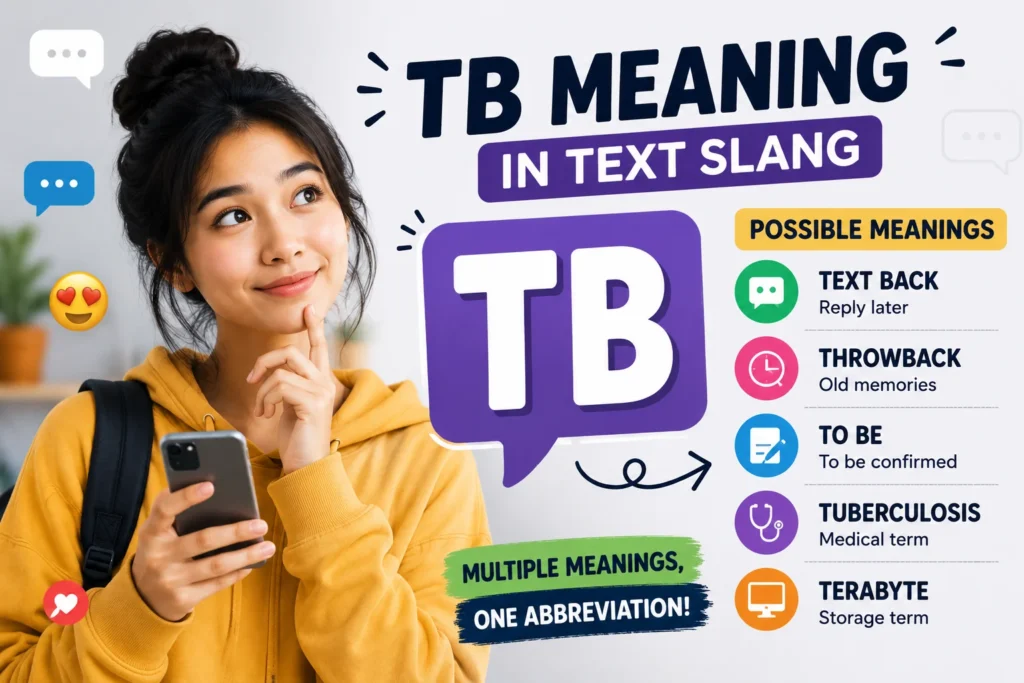

TB in text slang most commonly means “Text Back” or “Throwback,” depending on the conversation or platform. It can also stand for “To Be” and a few other genuine abbreviations. This guide explains every real meaning, where it’s used, and how to understand it correctly.
People search for “TB meaning in text slang” because they see it in text messages, Snapchat, Instagram captions, TikTok comments, and WhatsApp chats. Since TB has multiple legitimate meanings, context is essential to avoid misunderstanding what someone actually intends.
What Does TB Mean in Text Slang?
TB = Text Back (Most Common in Private Messages)
In texting, TB most commonly means “Text Back.” Someone uses it when they want the other person to reply later or remind them to continue the conversation.
Examples:
TB when you’re free.
Don’t forget to TB after work.
Here, TB simply means:
“Please text me back.”
This usage appears most often in:
- SMS
- Snapchat chats
- Messenger
- Discord DMs
It’s especially common between friends, couples, and family members who frequently exchange short messages.
TB = Throwback (Most Common on Social Media)
Outside private messaging, TB frequently means “Throwback.”
This meaning is especially popular on:
- TikTok
- X (Twitter)
Users post older photos or memories and refer to them as a TB or use hashtags like:
- #TB
- #Throwback
- #TBT (Throwback Thursday)
Example:
TB to our beach trip last summer.
Meaning:
Here’s an old memory from our vacation.
Although #TBT has become more common than simply TB, both refer to revisiting past memories.
TB = To Be
Another legitimate meaning is:
To Be
This abbreviation occasionally appears in notes, drafts, checklists, or informal planning messages.
Example:
Meeting time TB confirmed.
Meaning:
Meeting time to be confirmed.
You’ll often see similar phrases like:
- TB decided
- TB updated
- TB announced
Although this usage exists, it’s much less common in everyday text slang than Text Back or Throwback.
Other Genuine Meanings of TB
Depending on the context, TB can also represent other well-established abbreviations.
Tuberculosis (Medical)
In healthcare and medical discussions, TB refers to:
Tuberculosis
Example:
The patient tested positive for TB.
This is not slang and shouldn’t be confused with texting abbreviations.
Terabyte (Technology)
In computing, TB stands for:
Terabyte
Example:
My laptop has 2 TB of storage.
Again, this meaning belongs to technology rather than internet slang.
Which Meaning Is Most Common?
The intended meaning depends almost entirely on where you encounter TB.
| Context | Meaning |
|---|---|
| Text messages | Text Back |
| Snapchat chats | Text Back |
| Text Back | |
| Instagram captions | Throwback |
| TikTok captions | Throwback |
| Facebook memories | Throwback |
| Medical discussion | Tuberculosis |
| Technology | Terabyte |
| Notes & planning | To Be |
The surrounding conversation almost always makes the correct meaning obvious.
Is TB an Acronym, Abbreviation, or Slang?
TB is technically an initialism, meaning each letter represents the first letter of a word or phrase.
Examples include:
- Text Back
- Throwback
- To Be
- Terabyte
- Tuberculosis
Because users pronounce the letters individually (“tee-bee”), TB is classified as an initialism, a type of abbreviation.
When used in casual texting or social media, TB also functions as internet slang, particularly when referring to Text Back or Throwback.
TB Meaning on Different Platforms
TikTok
On TikTok, TB almost always means:
Throwback
Creators use it to revisit:
- childhood memories
- old trends
- previous relationships
- funny videos
- nostalgic moments
Example:
TB to when this dance was everywhere.
This usage is often accompanied by old videos or archived clips.
Instagram users primarily use TB to mean:
Throwback
It’s common in captions featuring older photographs.
Examples:
TB to my graduation.
TB from last summer.
Although #TBT (Throwback Thursday) remains more popular, many users simply write TB in captions.
Snapchat
On Snapchat, the most common meaning shifts back to:
Text Back
Examples:
TB when you wake up.
Don’t forget to TB.
Friends frequently use TB as a quick reminder to continue a conversation later.
Occasionally, users also post old memories labeled as a “TB,” but private messaging usage is much more common.
On WhatsApp, TB almost always means:
Text Back
Examples:
Busy now. TB later.
TB after dinner.
The abbreviation helps keep messages short while clearly requesting a reply.
X (Formerly Twitter)
Both meanings appear on X depending on the type of post.
Throwback
Example:
TB to my first concert.
Text Back
Less common but still possible in direct messages.
Since X is largely public-facing, Throwback is the meaning you’ll encounter most often.
How Can You Tell Which Meaning Someone Means?
The easiest way is to look at the conversation.
If someone says:
TB when you’re home.
They almost certainly mean:
Text Back
If someone posts:
TB to high school 😂
They clearly mean:
Throwback
Context removes nearly all confusion.
Why Does TB Have Multiple Meanings?
Many internet abbreviations develop naturally because people want to type faster.
Two-letter abbreviations like TB are short enough to represent different phrases in different settings.
Unlike newer slang that changes rapidly, TB’s major meanings have remained stable for years because each serves a different purpose:
- Text Back → messaging
- Throwback → social media
- To Be → planning
- Terabyte → technology
- Tuberculosis → medicine
This is why checking the platform and conversation is always more important than memorizing a single definition.
Tone & Context Variations
Although TB has several meanings, the tone depends on the context. In private chats, it usually means Text Back, while on social media it’s often Throwback. Here are the most common tone variations.
Funny Tone
Friends often use TB jokingly when someone is slow to reply.
Conversation
A: You disappeared for five hours!
B: Sorry, my phone died.
A: TB before next weekend. 😂
B: Deal!
Sarcastic Tone
TB can be used sarcastically when someone never responds.
Conversation
A: I texted you yesterday.
B: I know…
A: Maybe TB this century?
B: Ouch… I deserved that.
Playful Tone
Among close friends or couples, TB sounds lighthearted and friendly.
Conversation
A: I’m heading into class.
B: Good luck!
A: TB when you’re done.
B: Promise. 😊
Serious Tone
TB can simply be a genuine request for a reply.
Conversation
A: I’ll be in a meeting until 4.
B: Okay.
A: TB once you’re available.
B: Will do.
Real Chat Examples
Example 1 – WhatsApp
A: I’m driving right now.
B: Okay, TB when you get home.
A: Will do.
B: Stay safe.
Example 2 – Snapchat
A: I need your opinion.
B: Busy at work.
A: TB later then.
B: Definitely.
Example 3 – Instagram Caption
A: TB to our first road trip!
B: That weekend was unforgettable.
A: We should do it again.
B: Absolutely.
Example 4 – Messenger
A: I sent you the details.
B: I haven’t seen them yet.
A: Just TB whenever you’re free.
B: Sounds good.
Example 5 – TikTok Comments
A: TB to when this trend first started.
B: I remember everyone doing it.
A: Simpler times.
B: For sure.
Example 6 – Family Chat
A: Can you call Grandma today?
B: Yes.
A: TB afterward and let me know how she’s doing.
B: I will.
Example 7 – School Friends
A: Did you finish the assignment?
B: Almost.
A: TB once you’ve submitted it.
B: Okay!
Example 8 – Gaming Friends
A: Want to play tonight?
B: Maybe after dinner.
A: TB if you’re joining.
B: I’ll message you.
Example 9 – Dating Chat
A: I’m heading to the gym.
B: Have fun!
A: TB later tonight?
B: Of course. ❤️
Example 10 – Office Chat
A: I emailed the proposal.
B: Thanks.
A: TB after you’ve reviewed it.
B: I’ll send feedback this afternoon.
Example 11 – Throwback Post
A: TB to our graduation day.
B: That feels like yesterday.
A: Time flies.
B: It really does.
Example 12 – Group Chat
A: I’m offline for a while.
B: No problem.
A: TB if anything changes.
B: We will.
Grammar & Language Role
Part of Speech
TB is an initialism that functions as an abbreviation rather than a traditional part of speech.
Depending on the meaning, it can behave differently:
- Text Back – acts as a shortened verb phrase.
- Throwback – acts as a noun.
- To Be – acts as part of a phrase or sentence.
Examples:
TB when you arrive.
Nice TB from last summer.
Sentence Position
TB naturally appears in several positions.
Beginning
Usually in social media captions.
Example:
TB to our vacation in Italy.
Middle
Often appears inside a sentence.
Example:
Don’t forget to TB after school.
End
Common in texting.
Example:
I’m busy right now. TB later.
Can TB Replace a Full Sentence?
Sometimes, yes.
For example:
A: I’ll message you after work.
B: TB.
Here, TB means:
“Text me back.”
Likewise, on Instagram someone may simply caption an old photo:
TB
The audience understands it means Throwback without additional explanation.
Formal vs. Informal Register
TB is primarily an informal abbreviation.
Appropriate Uses
- Text messages
- Snapchat
- TikTok
- Discord
- Messenger
- Casual online conversations
Avoid Using TB In
- Academic writing
- Business reports
- Professional emails
- Legal documents
- Official correspondence
Instead, write the complete phrase:
- Text me back
- Throwback
- To be confirmed
Writing the full words avoids confusion in formal communication.
How to Reply When Someone Uses TB
The best way to reply depends on which meaning of TB the other person intends. If they mean “Text Back,” simply acknowledge that you’ll respond later. If they use “TB” to mean “Throwback,” it’s usually a chance to reminisce or comment on an old memory.
Funny Replies
If someone says:
TB when you get home.
You could reply:
- Only if you promise not to ignore me again. 😂
- I’ll text back… eventually.
- Challenge accepted.
- I’ll respond faster than last time!
If someone posts:
TB to high school.
You could comment:
- We all looked so different back then. 😂
- Those were the days!
- I can’t believe how long ago that was.
- Time really flies.
Serious Replies
For conversations where someone genuinely wants a reply.
Examples:
- I’ll text you as soon as I’m free.
- Thanks, I’ll get back to you shortly.
- I’ll reply after my meeting.
- Sure, I’ll message you tonight.
Flirty Replies
When the conversation is already romantic.
Examples:
- I’ll TB because you’re worth waiting for. ❤️
- You’ll be the first person I text.
- I was planning to message you anyway.
- Expect my text later tonight. 😉
Neutral Replies
Simple responses that work in almost any situation.
Examples:
- Sounds good.
- Will do.
- Okay.
- Thanks for letting me know.
- I’ll reply later.
- Sure.
TB Compared With Similar Slang Terms
Comparison Table
| Term | Meaning | Usage Context | Tone | Popularity | Confusion Risk |
|---|---|---|---|---|---|
| TB | Text Back / Throwback | Texting & social media | Casual | Very High | Medium |
| TBT | Throwback Thursday | Instagram, TikTok, Facebook | Nostalgic | Very High | Low |
| BRB | Be Right Back | Chats & gaming | Casual | High | Low |
| TTYL | Talk To You Later | Text messages | Friendly | High | Low |
| GTG | Got To Go | Ending conversations | Casual | High | Low |
| NRN (opposite) | No Reply Needed | Email & messaging | Neutral | Medium | Medium |
TB vs. TBT
People often confuse these abbreviations.
TB
Means:
- Text Back
- Throwback
Depending on context.
Example:
TB when you’re free.
or
TB to last summer.
TBT
Always means:
Throwback Thursday.
It’s specifically associated with posting old photos on Thursdays.
Example:
#TBT to my graduation.
TB vs. BRB
These abbreviations serve different purposes.
TB
Requests a reply.
Example:
TB after class.
BRB
Means:
Be Right Back.
Example:
BRB, someone’s at the door.
TB vs. TTYL
TTYL means:
Talk To You Later.
It ends a conversation politely.
Example:
Gotta go. TTYL!
TB, however, asks someone to send another message later.
TB vs. GTG
GTG means:
Got To Go.
It tells someone you’re leaving.
Example:
GTG, dinner’s ready.
TB instead requests future communication.
TB vs. NRN
NRN stands for:
No Reply Needed.
It’s essentially the opposite of Text Back.
Example:
Just letting you know—NRN.
Unlike TB, it specifically tells the recipient they don’t need to respond.
Who Uses TB?
Age Group Breakdown
TB is widely understood across multiple age groups, though its meaning varies depending on where it’s used.
Teenagers
Most often use TB as:
- Text Back
- Throwback
Especially on Snapchat, Instagram, and TikTok.
College Students
Frequently use TB in:
- Group chats
- Discord
Both “Text Back” and “Throwback” remain common.
Adults
Adults are more likely to use:
- Text Back
- Throwback
- To Be (in notes)
Professional users generally avoid TB in formal writing.
Gen Z vs. Millennials
Gen Z
Gen Z commonly uses:
- TB = Text Back
- TB = Throwback
Platforms include:
- TikTok
- Snapchat
- Discord
Millennials
Millennials typically associate TB with:
- Throwback photos
- Facebook memories
- Instagram captions
- WhatsApp chats
Many Millennials also remember when #TBT became one of Instagram’s biggest trends.
Regional Usage
TB is widely recognized throughout English-speaking countries.
Including:
- United States
- Canada
- United Kingdom
- Australia
- New Zealand
Because internet slang spreads globally, users in many non-English-speaking countries also recognize its common meanings.
Platform Breakdown
Snapchat
Most common meaning:
Text Back
Usually means:
Text Back
Most common meaning:
Throwback
TikTok
Usually:
Throwback
Mostly:
Throwback
Especially with older memories.
X (Twitter)
Both meanings appear, although Throwback is more common in public posts.
Origin & Internet Culture
Where Did TB Come From?
TB didn’t begin as a single slang word. Instead, it developed naturally because internet users wanted shorter ways to communicate.
Its two major slang meanings appeared independently:
- Text Back emerged in mobile texting culture during the rise of SMS and instant messaging.
- Throwback became popular through social media, especially after Instagram users started sharing nostalgic photos.
The Rise of Throwback Culture
During the early 2010s, users began posting old photos every Thursday using:
#ThrowbackThursday
Soon afterward, people shortened the phrase to:
- TBT
- TB
Although TBT remains the more recognizable hashtag, TB is still commonly used in captions and comments.
Text Back in Modern Messaging
As texting became faster, people started shortening common requests.
Instead of writing:
Text me back later.
Many simply wrote:
TB later.
This abbreviation became especially common among friends and family who text frequently.
Why TB Has Multiple Meanings
Unlike newer slang that often disappears after a few months, TB has survived because its meanings belong to different contexts:
- Messaging → Text Back
- Social media → Throwback
Since the surrounding conversation almost always reveals which meaning is intended, both definitions continue to coexist without causing much confusion.
Safety & Appropriateness
Is TB Rude or Offensive?
No. TB is not considered rude, offensive, or profane. It’s a neutral abbreviation whose tone depends on the conversation.
For example:
- Friendly: “TB when you get home.”
- Helpful: “TB if you have any questions.”
- Nostalgic: “TB to our first vacation together.”
The abbreviation itself is harmless. However, if someone repeatedly says “TB” while ignoring your messages, it may come across as inconsiderate—but that’s about the behavior, not the abbreviation.
Is TB Appropriate for School?
Yes.
Students commonly use TB in:
- Class group chats
- Study groups
- Snapchat
- Discord
Example:
TB after you’ve finished the homework.
However, avoid using TB in:
- Essays
- Formal assignments
- Academic reports
Write the complete phrase (“Text Back” or “Throwback”) when submitting schoolwork.
Is TB Appropriate at Work?
It depends on the setting.
TB works well in:
- Internal Slack conversations
- Microsoft Teams chats
- Informal workplace messaging
Example:
TB after you’ve reviewed the document.
For formal emails or client communication, writing “please reply” or “please get back to me” sounds more professional.
Does TB Contain Profanity?
No.
TB contains:
- No profanity
- No explicit language
- No offensive wording
- No adult content
It’s suitable for general audiences and can safely be used in most casual conversations.
Cultural Sensitivity
The slang meanings of TB—particularly Text Back and Throwback—do not originate from AAVE or any specific cultural community. They developed naturally through mobile texting and social media use.
As a result, there are no notable cultural sensitivity concerns associated with the abbreviation. The only thing to be mindful of is context, since TB has legitimate meanings in medicine (Tuberculosis) and technology (Terabyte) outside internet slang.
Real-World Observation
One reason TB remains popular is that it represents two very different but equally common online habits: staying connected and looking back at memories. In private conversations, “TB” keeps communication quick by replacing “text back.” On social media, it allows people to instantly recognize nostalgic posts without needing a long explanation. This flexibility has helped TB remain relevant across texting apps and social platforms, even as newer slang terms come and go.
Frequently Asked Questions
What does TB mean in text messages?
In text messages, TB most commonly means “Text Back.” It’s a short way of asking someone to reply later when they’re available. Friends, family members, and couples frequently use it in casual conversations.
What does TB mean on Instagram?
On Instagram, TB usually stands for “Throwback.” Users add it to captions when sharing older photos or memorable moments. It’s closely related to the well-known hashtag #TBT (Throwback Thursday).
Is TB the same as TBT?
Not exactly. TBT always means Throwback Thursday, while TB can mean either Throwback or Text Back, depending on the situation. On Instagram, the meanings are closely related, but in private chats TB usually refers to texting back.
What does TB mean on Snapchat?
On Snapchat, TB most often means “Text Back.” Someone might say, “TB later,” to ask you to reply after you’re free. Less commonly, TB may refer to a throwback memory shared through Stories.
Can TB mean “To Be”?
Yes. In notes, schedules, and planning documents, TB can mean “To Be.” For example, “Meeting location TB confirmed” means the location is still to be confirmed. This usage is less common in everyday text slang.
Is TB still popular?
Yes. TB remains widely used because its meanings are practical and easy to understand. Whether asking someone to text back or sharing a throwback photo, the abbreviation continues to appear across messaging apps and social media.
Should I use TB in professional emails?
Generally, no. While coworkers may understand it in internal chats, formal emails should use complete phrases such as “please reply,” “get back to me,” or “throwback photo.” Writing out the words avoids confusion and sounds more professional.
What is the difference between TB and TBT?
TB has multiple meanings, including Text Back and Throwback. TBT specifically stands for Throwback Thursday and is mainly used when posting nostalgic content on Thursdays. If you see #TBT, it always refers to the social media trend.
Why do people say TB instead of “Text Back”?
People shorten common phrases to save time while texting. Just like BRB or TTYL, TB lets users communicate quickly without typing the full phrase. It’s especially useful in fast-paced chats.
Is TB internet slang?
Yes. When it means Text Back or Throwback, TB is considered internet slang. However, it also has standard abbreviations outside slang, such as Terabyte in technology and Tuberculosis in medicine.
Can TB have different meanings in different conversations?
Absolutely. The same abbreviation can represent different phrases depending on the platform and context. That’s why it’s important to consider whether you’re reading a text message, a social media caption, or a technical discussion.
Conclusion
TB is a versatile internet abbreviation with several genuine meanings, but in everyday online communication it most commonly stands for “Text Back” in messaging apps and “Throwback” on social media. Context is the key to understanding which definition applies.
Whether you’re chatting with friends, posting nostalgic photos, or reading online conversations, recognizing these meanings helps you avoid confusion and communicate more naturally.
Usage Tips
- Use TB to mean Text Back in casual messaging.
- Use TB for Throwback when sharing old memories online.
- Pay attention to the platform and conversation before assuming the meaning.
- Write the full phrase in formal writing or professional communication.
Common Mistakes
- Assuming TB always means Throwback.
- Using TB in formal emails or academic papers.
- Confusing TB with TBT (Throwback Thursday).
- Forgetting that TB also has non-slang meanings like Terabyte and Tuberculosis.
When to Use TB
Use TB when:
- Sending casual text messages.
- Asking someone to reply later.
- Sharing nostalgic photos on social media.
- Chatting with friends or family online.
When to Avoid TB
Avoid TB when:
- Writing professional reports.
- Sending formal client emails.
- Creating academic assignments.
- Communicating where multiple meanings could cause confusion.