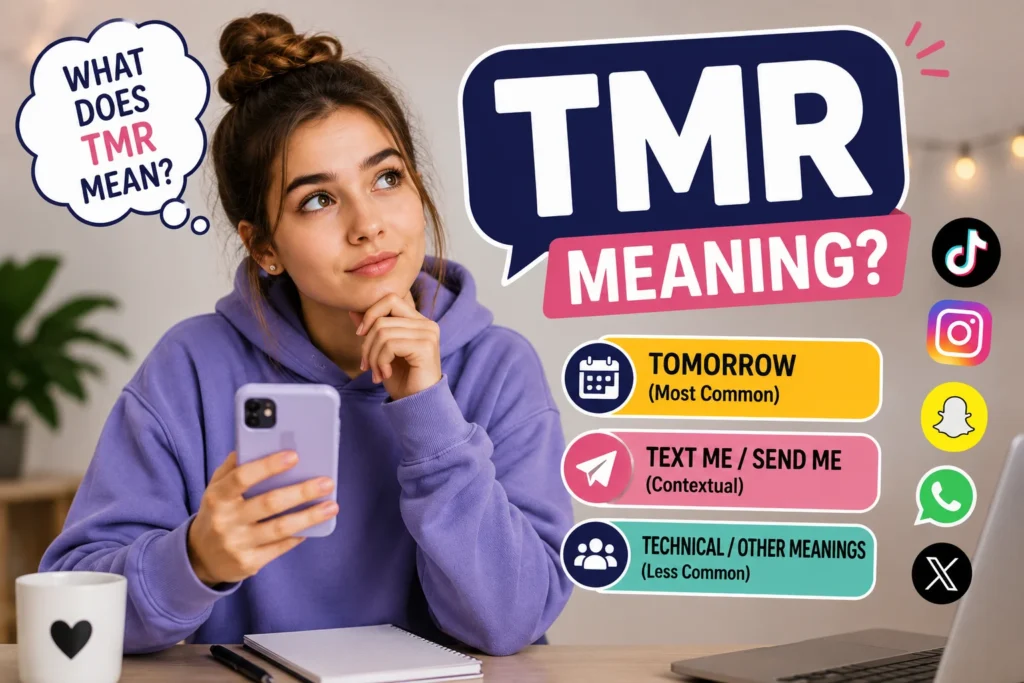

TMR most commonly means “tomorrow” in texting, Snapchat, TikTok, WhatsApp, and social media. It is a shortened abbreviation people use to save time while chatting. Depending on context, TMR can occasionally have technical meanings, but “tomorrow” is by far the meaning most people are searching for.
If you’ve received a message like “I’ll call you tmr” or “See you tmr,” the sender simply means tomorrow. The abbreviation is popular because it is quick to type and instantly understood by most internet users.
What Does TMR Mean?
In online conversations, TMR stands for “tomorrow.” It is a texting abbreviation used when discussing plans, appointments, events, deadlines, or anything scheduled for the next day.
Examples:
- “Let’s finish it tmr.”
- “See you tmr morning.”
- “I’ll text you tmr.”
The abbreviation removes vowels from the word “tomorrow,” making it faster to type on mobile devices.
Meaning & Explanation
TMR = Tomorrow (Most Common Meaning)
The overwhelming majority of people use TMR as shorthand for tomorrow.
Examples:
- “Meeting moved to tmr.”
- “I’ll send it tmr.”
- “Talk to you tmr.”
Unlike many internet slang terms, TMR is simply an abbreviation rather than a slang word with a separate meaning.
Is TMR an Acronym, Abbreviation, or Slang?
TMR is best classified as an abbreviation.
It shortens the existing word “tomorrow” without changing its meaning.
Characteristics:
- Not a new slang term
- Not a phrase acronym
- Primarily used for convenience
- Common in casual digital communication
Other Meanings of TMR
Outside texting, TMR can occasionally mean:
- Total Mixed Ration (agriculture)
- Trans-Membrane Receptor (biology)
- Technical Maintenance Report (industry-specific)
However, these meanings are rare in social media conversations.
When someone searches “TMR meaning” in a texting context, they almost always mean tomorrow.
Platform Breakdown
TikTok
TikTok users frequently use TMR in comments and captions.
Examples:
- “Part 2 dropping tmr.”
- “Can’t wait for the update tmr.”
Creators often use it when announcing future content.
On Instagram, TMR appears in:
- Stories
- DMs
- Captions
- Comment sections
Examples:
- “New photos tmr.”
- “See everyone tmr.”
Snapchat
Snapchat users commonly shorten words.
Examples:
- “Let’s hang out tmr.”
- “I’ll snap you tmr.”
Because chats are fast-paced, abbreviations like TMR fit naturally.
WhatsApp conversations frequently include TMR.
Examples:
- “Doctor appointment tmr.”
- “Talk later, busy tmr.”
X (Formerly Twitter)
Due to character-saving habits, TMR remains common on X.
Examples:
- “Video coming tmr.”
- “Results announced tmr.”
Tone & Context Variations
Funny Tone
A: Did you finish the assignment?
B: Nope.
A: When will you finish it?
B: Future me will handle it tmr.
Sarcastic Tone
A: You said you’d start exercising today.
B: I know.
A: So did you?
B: Definitely starting tmr.
Playful Tone
A: Movie night tonight?
B: Can’t.
A: What about tmr?
B: Now you’re speaking my language.
Serious Tone
A: We need to discuss the proposal.
B: Agreed.
A: Can we meet tmr morning?
B: Yes, that works.
Real Chat Examples
Example 1
A: Are you free?
B: Not today.
A: What about tmr?
B: That works.
Example 2
A: Did you book the tickets?
B: Not yet.
A: Please do it tmr.
B: I will.
Example 3
A: Can you send the notes?
B: Sure.
A: Tonight?
B: Probably tmr.
Example 4
A: What time is the meeting?
B: 10 AM.
A: Today?
B: No, tmr.
Example 5
A: Want coffee?
B: Busy today.
A: Then tmr?
B: Sounds good.
Example 6
A: Did your package arrive?
B: Not yet.
A: Delivery estimate?
B: Tmr afternoon.
Example 7
A: Ready for the exam?
B: Almost.
A: Good luck tmr.
B: Thanks.
Example 8
A: When are you posting the video?
B: Tmr evening.
A: Looking forward to it.
B: Appreciate it.
Example 9
A: Did your interview go well?
B: It’s actually tmr.
A: Good luck then.
B: Thank you.
Example 10
A: Family dinner tonight?
B: We’re doing it tmr instead.
A: Got it.
B: See you then.
Example 11
A: Are you available for gaming?
B: Not tonight.
A: Tmr?
B: Definitely.
Example 12
A: When does the sale start?
B: Tmr morning.
A: Perfect.
B: Don’t miss it.
Grammar & Language Role
Part of Speech
TMR functions as an abbreviated form of the noun/adverb “tomorrow.”
Examples:
- “See you tmr.”
- “Meeting is tmr.”
Sentence Position
TMR commonly appears:
- At the end of a sentence
- After scheduling information
- Following future plans
Examples:
- “Talk later, tmr.”
- “Let’s finish it tmr.”
Can TMR Replace a Full Sentence?
Sometimes.
Example:
A: When?
B: TMR.
Because the meaning is clear from context, it can function as a complete response.
Formal vs Informal Register
TMR is highly informal.
Appropriate:
- Text messages
- Social media
- Group chats
- Casual conversations
Not ideal:
- Business reports
- Academic writing
- Legal documents
- Professional correspondence
How to Reply to TMR
Funny Reply
“Tomorrow never seems to arrive.”
Serious Reply
“Sounds good. I’ll be ready.”
Flirty Reply
“Only if I get to see you tmr.”
Neutral Reply
“Okay, talk to you tomorrow.”
Comparison Table
| Term | Meaning | Usage Context | Tone | Popularity | Confusion Risk |
|---|---|---|---|---|---|
| TMR | Tomorrow | Texting & social media | Neutral | Very High | Low |
| TMRW | Tomorrow | Texting | Neutral | High | Low |
| TMW | Tomorrow | Messaging | Neutral | Medium | Medium |
| BRB | Be Right Back | Chatting | Neutral | Very High | Low |
| L8R | Later | Casual texting | Casual | Medium | Low |
| ASAP | As Soon As Possible | Opposite urgency concept | Urgent | Very High | Low |
Who Uses TMR?
Teenagers
Gen Z frequently uses TMR in:
- Snapchat
- TikTok
- Instagram DMs
- Group chats
Millennials
Millennials often use TMR in:
- SMS
- Messenger
- Workplace chats
Adults
Many adults use TMR because it saves time and remains easy to understand.
Regional Usage
United States
Very common in texting.
United Kingdom
Widely recognized and frequently used.
Australia
Popular in mobile messaging.
Global English-Speaking Communities
Common across countries where English texting abbreviations are used.
Platform Usage Summary
| Platform | Common Meaning |
|---|---|
| TikTok | Tomorrow |
| Tomorrow | |
| Snapchat | Tomorrow |
| Tomorrow | |
| X | Tomorrow |
Origin & Internet Culture
Early SMS Origins
TMR emerged during the era of SMS messaging.
Early mobile phones required multiple key presses for each letter, encouraging users to shorten words whenever possible.
Character Limits
Text messaging originally had strict character limits.
Users shortened common words such as:
- Tomorrow → TMR
- Later → L8R
- Before → B4
This made communication faster and more efficient.
Social Media Adoption
As social platforms expanded, users carried texting habits with them.
TMR became common on:
- Snapchat
- TikTok
Why TMR Survived
Many older abbreviations disappeared, but TMR remained useful because:
- It’s intuitive
- It’s easy to read
- It saves typing
- It avoids confusion
Safety & Appropriateness
Is TMR Offensive?
No.
Is It Profanity?
No.
Does It Contain Explicit Language?
No.
Is It Safe for School?
Yes.
Is It Appropriate for Work?
Only in informal internal messaging.
For professional emails, spelling out “tomorrow” is generally better.
Cultural Sensitivity Notes
There are no known cultural concerns associated with TMR.
It is considered a neutral abbreviation.
Real-World Observation
TMR is one of those internet abbreviations that works because it solves a practical problem. People make plans constantly, and “tomorrow” is one of the most frequently typed words in messaging. Shortening it to TMR saves time while remaining instantly recognizable. Unlike trend-based slang that comes and goes, TMR survives because it serves a clear communication purpose that transcends age groups and platforms.
Frequently Asked Questions
What does TMR mean in texting?
TMR almost always means “tomorrow.” People use it to discuss plans, schedules, appointments, or events happening the next day. It is one of the most common texting abbreviations.
What does TMR mean on Snapchat?
On Snapchat, TMR means tomorrow. Users often write messages like “talk tmr” or “see you tmr” because abbreviations are common in fast-paced chats.
What does TMR mean on TikTok?
TikTok users typically use TMR to announce future content or events. Comments such as “Part 2 coming tmr” are extremely common.
Is TMR slang?
Not exactly. TMR is primarily an abbreviation rather than slang. It shortens the word tomorrow without changing its meaning.
What does “see you tmr” mean?
It means “see you tomorrow.” The abbreviation simply replaces the full word tomorrow for convenience.
Is TMR appropriate for professional communication?
In casual workplace chats, it may be acceptable. However, professional emails and formal documents should usually spell out “tomorrow” completely.
Why do people use TMR instead of tomorrow?
The main reason is speed. Short abbreviations make typing faster and fit naturally into texting culture.
Are TMR and TMRW the same thing?
Yes. Both abbreviations mean tomorrow. TMR is shorter, while TMRW more closely resembles the original spelling.
Conclusion
TMR most commonly means “tomorrow” across texting, Snapchat, TikTok, Instagram, WhatsApp, and X. It is a simple abbreviation designed to make conversations faster and easier.
Usage Tips
- Use TMR in casual texts and chats.
- Understand that it almost always means tomorrow.
- Use context to confirm meaning.
- Keep it for informal communication.
Common Mistakes
- Thinking TMR is a complex slang term.
- Using it in formal writing.
- Assuming it has hidden meanings.
- Confusing it with technical abbreviations.
When to Use TMR
Use it when:
- Texting friends
- Messaging family
- Posting casually online
- Making plans
Avoid it when:
- Writing professional emails
- Creating formal reports
- Completing academic assignments
- Communicating in official documents