
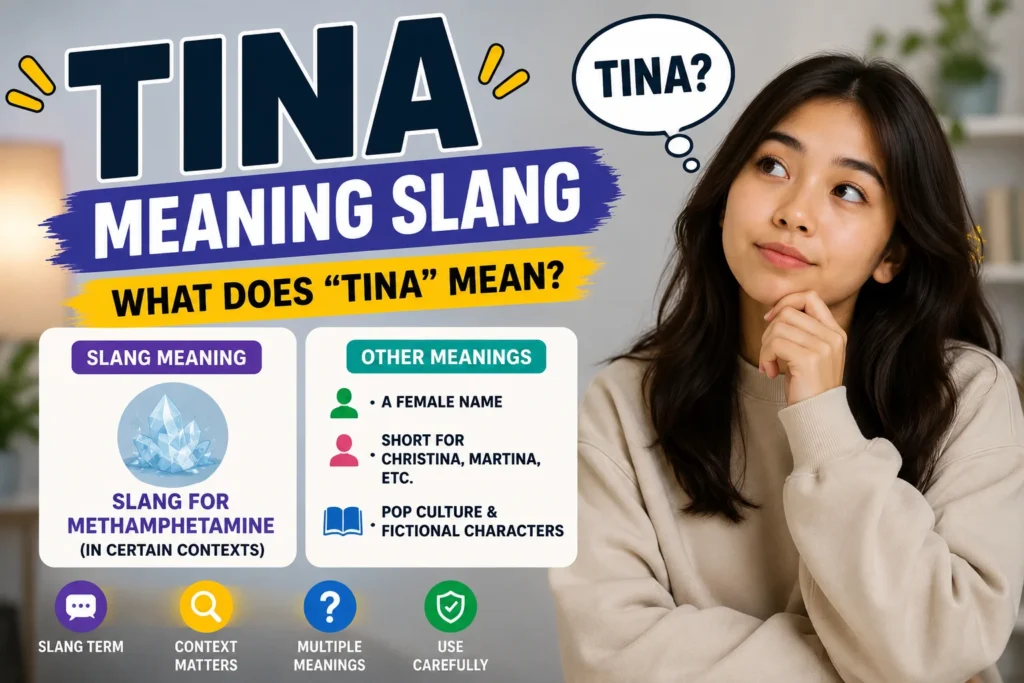

In slang, “Tina” is most commonly a coded nickname for methamphetamine in certain communities. It is not a mainstream internet slang term like “LOL” or “WTH.” Most people search this phrase after seeing it in online conversations, dating profiles, news reports, or recovery-related discussions and want to understand its meaning without confusion.
Because the word has multiple meanings—including a common female name—many people are surprised to learn it can also be used as slang. This guide explains the meaning factually, where it appears, how it’s used, and how to recognize it in context without promoting or normalizing harmful behavior.
What Does Tina Mean in Slang?
The slang term “Tina” is a coded nickname for methamphetamine. It is primarily encountered in discussions related to drug awareness, addiction recovery, public health, or law enforcement rather than everyday texting.
Unlike popular internet abbreviations such as BRB, IMO, or SMH, “Tina” is not used as a reaction, joke, or casual conversation starter. Its meaning depends entirely on context.
Someone might encounter the term while:
- Reading news articles
- Watching documentaries
- Seeing discussions about substance abuse
- Browsing public forums
- Reading educational health content
- Seeing references in dating profiles or online communities
If someone casually introduces themselves as Tina, they are almost certainly referring to their name—not the slang meaning.
Context is everything.
Meaning & Explanation
The Primary Meaning
Today, the most widely recognized slang meaning of “Tina” is a coded nickname for methamphetamine.
The nickname developed as a discreet way for some people to reference the drug without writing its actual name.
Today, public health organizations, journalists, educators, and addiction recovery resources often explain the term so readers understand conversations where it appears.
Importantly, using the word does not automatically mean someone uses drugs. Many people search the phrase simply because they encountered it online and want to understand what it means.
Why Do People Search “Tina Meaning Slang”?
Search interest has increased because people encounter the word in different places, including:
- News stories
- Social media discussions
- Crime reports
- Educational articles
- Recovery communities
- Television shows
- Online dating conversations
Rather than assuming the meaning, people search to understand the context safely and accurately.
Other Meanings of Tina
Not every use of “Tina” refers to slang.
Depending on the conversation, it may simply mean:
- A common female first name
- A nickname for Christina, Martina, Valentina, or Bettina
- A fictional character
- A celebrity’s name
- A song title
- A brand name
This is why context matters so much.
For example:
“Tina is coming over tonight.”
This almost certainly refers to a person.
Compare that with:
“I didn’t realize ‘Tina’ meant something different in that documentary.”
Here, the speaker is discussing the slang meaning.
Is Tina an Acronym, Abbreviation, or Slang?
“Tina” is slang.
It is not:
- an acronym
- an abbreviation
- an initialism
- a texting shortcut
Instead, it is a coded nickname that developed over time within certain communities.
Unlike internet slang such as:
- LOL
- WTH
- FTFY
- OMW
“Tina” cannot be understood without cultural context.
How Tina Appears on Different Platforms
TikTok
TikTok generally limits or moderates content related to illegal drugs.
When the slang appears, it’s usually in:
- educational videos
- recovery stories
- awareness campaigns
- news commentary
It is not commonly used as everyday Gen Z slang.
On Instagram, “Tina” is occasionally mentioned in:
- educational posts
- nonprofit organizations
- addiction awareness content
- health education
Most ordinary Instagram users never use it as casual slang.
Snapchat
“Tina” is not a mainstream Snapchat abbreviation.
Unlike abbreviations such as:
- TBH
- FR
- WYD
it isn’t commonly used among friends in everyday chats.
If it appears, the surrounding conversation usually makes the meaning clear.
The slang rarely appears in ordinary WhatsApp conversations.
More commonly, it may appear when someone shares:
- educational articles
- public health resources
- news reports
- recovery information
X (formerly Twitter)
X contains more public conversations about current events than many messaging apps.
Here, the slang may appear in discussions involving:
- journalism
- public policy
- crime reporting
- health education
- addiction recovery
Again, it is not used as a humorous internet reaction like many common abbreviations.
Tone & Context Variations
Unlike casual internet slang such as LOL or OMW, “Tina” doesn’t change meaning based on emotion. Instead, the tone of the conversation determines how the term is understood. In most situations, people use it in educational, news, recovery, or awareness contexts rather than everyday texting.
Serious Tone
This is the most common way the slang appears.
A: I watched a documentary last night and they kept mentioning “Tina.”
B: They’re using it as slang for methamphetamine.
A: I had no idea that was what it meant.
B: It’s a coded nickname used in certain communities.
Informative Tone
Someone may simply be asking for clarification.
A: What does “Tina” mean in that article?
B: It’s slang, not someone’s name in that context.
A: Thanks for explaining.
B: Context makes a huge difference.
Curious Tone
Many conversations begin because someone notices the unfamiliar term online.
A: I saw people mentioning “Tina” on a discussion forum.
B: They’re probably referring to the slang meaning.
A: I thought it was someone’s name.
B: A lot of people make that mistake.
Cautious Tone
The word also appears in awareness conversations.
A: Someone told me to be aware of coded slang online.
B: That’s a good idea.
A: I didn’t realize “Tina” could mean something different.
B: Learning common terms helps avoid confusion.
Real Chat Examples
These conversations reflect realistic situations where someone encounters the slang and asks about it. They are designed to educate without promoting harmful behavior.
Example 1
A: What does “Tina” mean in this article?
B: It’s slang for methamphetamine.
A: I honestly thought they meant a person.
B: The context changes everything.
Example 2
A: Why is everyone saying “Tina” instead of the actual word?
B: It’s a coded nickname.
A: That makes much more sense now.
B: It’s commonly explained in educational resources.
Example 3
A: I saw “Tina” mentioned in a documentary.
B: They were probably using the slang meaning.
A: I didn’t recognize it.
B: Most people don’t until they look it up.
Example 4
A: My friend asked if I knew what “Tina” meant.
B: Did they mean the slang?
A: Yes.
B: It’s good you asked instead of guessing.
Example 5
A: Is Tina internet slang like LOL?
B: No.
A: So it’s different?
B: Yes, it’s a coded nickname used in specific contexts.
Example 6
A: I thought Tina was just a girl’s name.
B: Usually it is.
A: So why does it have another meaning?
B: Some words develop different meanings over time depending on context.
Example 7
A: Someone mentioned Tina during a news interview.
B: They weren’t talking about a person.
A: Now I understand.
B: News stories often explain the meaning for viewers.
Example 8
A: Why doesn’t everyone know this slang?
B: Because it isn’t part of everyday texting.
A: That explains why I’d never heard it.
B: Most people only encounter it through news or educational content.
Example 9
A: I searched “Tina meaning slang.”
B: That’s how most people discover it.
A: I wanted to be sure before assuming.
B: That’s always the best approach.
Example 10
A: Is Tina commonly used on social media?
B: Mostly in awareness or educational discussions.
A: Not like viral slang?
B: Exactly.
Grammar & Language Role
Part of Speech
In its slang sense, Tina functions as a noun because it refers to a specific thing.
Examples:
- “They mentioned Tina in the documentary.”
- “I didn’t understand what Tina meant.”
Sentence Position
“Tina” most commonly appears:
- After verbs like mention, mean, hear, discuss, or reference
- As the object of a sentence
- Occasionally as the subject
Examples:
- “What does Tina mean?”
- “They explained Tina during the interview.”
- “Tina was mentioned several times.”
Can It Replace a Full Sentence?
No.
Unlike abbreviations such as:
- LOL
- OMG
- SMH
“Tina” cannot stand alone as a complete reaction.
It functions as a noun that requires surrounding context.
Formal vs. Informal Register
The slang itself is informal, but discussions about it often appear in formal contexts such as:
- Public health articles
- News reports
- Educational resources
- Academic discussions
Because of this, readers may encounter the term in both formal writing and casual online conversations.
How to Reply When Someone Says “Tina”
Your response depends on whether the person is asking about the slang or using it in an educational discussion.
Funny Reply
Since this slang relates to a serious subject, humorous replies are generally not appropriate. If someone simply mistakes it for a person’s name, a lighthearted response might be:
- “I thought you meant someone named Tina too!”
Serious Reply
- “In that context, it’s slang rather than a person’s name.”
- “It refers to methamphetamine in certain discussions.”
- “Context is important because Tina is also a common first name.”
- “Many people search the meaning after seeing it in news or documentaries.”
Neutral Reply
- “It depends on the context.”
- “There are multiple meanings.”
- “Most articles explain the slang definition.”
- “Looking at the surrounding conversation usually makes it clear.”
Flirty Reply
A flirty reply is not appropriate because the slang relates to a sensitive topic. Keeping responses respectful and informative is the best approach.
Comparison Table
Because “Tina” is a coded slang term rather than a typical internet abbreviation, it’s often confused with other names or slang words. The table below compares Tina with related terms that people frequently search alongside it.
| Term | Meaning | Usage Context | Tone | Popularity | Confusion Risk |
|---|---|---|---|---|---|
| Tina | Slang nickname for methamphetamine | Public health discussions, recovery resources, news reports | Neutral/Serious | Medium | High |
| Ice | Another slang term for methamphetamine | News, awareness campaigns, law enforcement | Neutral/Serious | High | Medium |
| Crystal | Shortened reference to crystal meth | Educational and public awareness contexts | Neutral/Serious | High | Medium |
| Meth | Standard shortened form of methamphetamine | Medical, educational, legal, and news discussions | Neutral | Very High | Low |
| Party and Play (PnP) | Term sometimes seen in discussions involving drug use and sexual activity | Public health education and awareness | Serious | Medium | Medium |
| Tina (Personal Name) (Contrasting meaning) | A common female first name | Everyday conversations, workplaces, schools | Neutral | Very High | Very High |
How These Terms Differ
Although these words may appear in similar discussions, they are not interchangeable.
- Tina is a coded nickname used in specific communities.
- Meth is the standard shortened name used by medical professionals and journalists.
- Ice commonly refers to the crystalline form of methamphetamine in many English-speaking countries.
- Crystal is another widely recognized nickname, especially in news reporting.
- Tina as a person’s name has absolutely no connection to the slang meaning unless the surrounding context clearly indicates otherwise.
Understanding these distinctions prevents misunderstandings when reading articles, social media posts, or public health information.
Who Uses This Term?
Unlike popular internet slang such as LOL, FR, or WTH, the slang meaning of Tina is not widely used in everyday conversations.
Age Group Breakdown
Teenagers
Most teenagers are unlikely to encounter the slang through ordinary texting.
When they do, it’s usually because of:
- Educational programs
- News stories
- Online awareness content
- Questions about unfamiliar internet terms
Young Adults (18–35)
Young adults are more likely to encounter the slang through:
- News reports
- Online discussions
- Public health campaigns
- Dating app safety articles
- Recovery-related resources
However, it still isn’t considered mainstream texting slang.
Adults (35+)
Older adults often recognize the term from:
- Journalism
- Television documentaries
- Public awareness campaigns
- Medical or legal discussions
Many people in this age group have never encountered the slang until seeing it explained in educational content.
Gen Z vs Millennials
Gen Z
Gen Z generally does not use “Tina” as everyday slang.
If they recognize it, it’s often because they encountered:
- Educational TikTok videos
- News commentary
- Awareness posts
- Documentary clips
Unlike terms such as Rizz, NPC, or Delulu, Tina has never become mainstream Gen Z vocabulary.
Millennials
Millennials are somewhat more likely to recognize the term because of:
- Media coverage
- Online forums
- Public health messaging
- News reporting over the past two decades
Even so, most Millennials rarely use it in casual conversations.
Regional Usage
United States
The slang meaning is most widely recognized in the United States, particularly in educational, medical, legal, and public health contexts.
It is not tied to a particular state or city but appears nationally in awareness materials.
United Kingdom
The UK more commonly uses direct terminology such as meth or crystal meth in official communication.
“Tina” may still appear, but it is less widely recognized by the general public.
Australia
Australian public health organizations occasionally explain the slang in educational materials, although everyday conversations more often use standard terminology.
Global Usage
Internationally, recognition of “Tina” varies considerably.
Many English speakers outside North America may never encounter the slang unless reading international news or educational resources.
Platforms Where the Slang Appears
Unlike viral abbreviations, “Tina” does not have strong platform-specific popularity.
TikTok
The term appears mostly in:
- Educational videos
- Recovery stories
- Public awareness campaigns
It is not used as a humorous trend or reaction.
Instagram posts mentioning Tina are usually created by:
- Health organizations
- Educational creators
- News outlets
- Nonprofit organizations
Snapchat
There is no evidence that Tina functions as everyday Snapchat slang.
If the word appears, it is usually because someone is discussing its meaning rather than using it as casual shorthand.
WhatsApp conversations rarely include this slang unless people are sharing:
- News articles
- Awareness campaigns
- Educational information
X (formerly Twitter)
Public conversations on X sometimes reference Tina in relation to:
- Breaking news
- Public health
- Crime reporting
- Educational threads
Again, it is used descriptively rather than as entertainment slang.
Origin & Internet Culture
Real Origin
The slang term “Tina” developed as a coded nickname for methamphetamine within certain communities. Linguists generally believe it emerged as a discreet way to reference the drug without using its full name directly.
Unlike abbreviations such as LOL or OMG, it did not originate from texting culture or internet messaging.
How It Spread
The term became more widely recognized through:
- Journalism
- Public health campaigns
- Recovery organizations
- Documentaries
- Online educational resources
Its increased visibility comes from awareness efforts rather than popularity as internet slang.
Social Media Influence
Social media has made more people aware of the term, but not because it became trendy.
Instead, creators use it when discussing:
- Drug education
- Safety
- Recovery
- News events
Platforms generally moderate or limit content involving illegal drugs, so educational uses are far more common than casual ones.
Meme Culture
“Tina” has virtually no role in meme culture.
Unlike expressions such as:
- “No cap”
- “Rizz”
- “Mid”
- “Bet”
it is not used for humor or viral trends.
Evolution Over Time
Originally understood only within limited circles, Tina has gradually become more recognizable to the public because journalists and educators often explain its meaning in news reports and awareness campaigns.
Today, most people who search “Tina meaning slang” are simply trying to understand something they recently encountered—not looking for a new internet phrase to use.
Safety & Appropriateness
Is Tina a Rude Word?
No.
The word itself is not offensive. However, because it refers to an illegal drug in certain contexts, it should be used carefully and only when discussing the topic factually.
Does It Contain Profanity?
No.
“Tina” contains no profanity or explicit language.
Is It Appropriate for School?
It may be appropriate in educational settings when discussing:
- Health education
- Drug awareness
- Public safety
- Media literacy
Teachers and students may encounter the term in educational materials designed to explain slang used in news or online discussions.
Is It Appropriate at Work?
In professional environments, Tina should generally only be mentioned when relevant to:
- Healthcare
- Public health
- Law enforcement
- Journalism
- Education
- Research
It is not suitable as casual workplace conversation.
Cultural Sensitivity
When discussing the slang meaning, it’s important to remain factual and avoid jokes or casual use. The term is connected to a serious public health issue, so accurate and respectful language is the most appropriate approach.
Real-World Observation
Most people who search “Tina meaning slang” are not trying to learn trendy internet vocabulary—they simply encountered the word in a news article, documentary, online discussion, or educational video and wanted clarification. Unlike fast-moving social media slang, Tina remains a context-specific coded term. Understanding its meaning helps readers interpret conversations accurately while recognizing that, in most everyday situations, Tina is simply a common first name. This difference highlights why context is essential whenever unfamiliar slang appears online.
Frequently Asked Questions
What Does “Tina” Mean in Slang?
In slang, “Tina” is a coded nickname for methamphetamine used in certain communities. It is not a mainstream texting abbreviation or Gen Z catchphrase. Most people encounter the term in news reports, documentaries, public health resources, or discussions related to addiction awareness.
Is “Tina” a Common Internet Slang Term?
No. Unlike abbreviations such as LOL, BRB, or WTH, “Tina” is not commonly used in everyday online conversations. Most social media users will never use the term unless they are discussing its meaning or sharing educational content.
Why Is Methamphetamine Called “Tina”?
The exact origin isn’t fully documented, but researchers believe “Tina” developed as a coded nickname to reference methamphetamine without using its actual name. Over time, journalists, educators, and recovery organizations began explaining the term so the public could recognize it when encountered online or in media.
Does “Tina” Always Mean the Drug?
No. In most situations, Tina is simply a female first name. Only when the surrounding conversation clearly involves drug-related discussions does it carry the slang meaning. Reading the entire conversation or article is the best way to understand which definition is intended.
Is “Tina” Used on TikTok?
Occasionally, yes—but primarily in educational or awareness content. You might see creators explaining unfamiliar slang, discussing documentaries, or sharing public health information. It is not a popular TikTok trend or everyday expression used in casual comments.
Is “Tina” Offensive?
The word itself is not offensive or profane. However, because it refers to an illegal drug in certain contexts, it should be used carefully and respectfully. It is best discussed in educational, journalistic, or public health settings rather than as a joke.
Should I Use the Slang Meaning of “Tina”?
Generally, no. Since many people know Tina only as a personal name, using it as slang can easily confuse others. Unless you’re discussing its meaning in an educational or informational context, it’s better to avoid using the coded slang.
Why Do People Search “Tina Meaning Slang”?
Most searches come from people who unexpectedly encounter the term in a documentary, news article, social media discussion, or recovery-related content. They simply want to understand the meaning without misunderstanding the conversation.
Is Tina a Code Word?
Yes. In certain communities, Tina functions as a coded nickname for methamphetamine. Outside those contexts, however, it usually refers to a person’s name and has no slang meaning.
Is Tina the Same as Meth?
When used as slang, yes. “Tina” refers to methamphetamine. However, meth is the standard term used in medical, legal, and educational settings, while “Tina” is a coded nickname found in some communities.
Is Tina Used in Everyday Text Messages?
Not typically. Unlike common texting abbreviations, “Tina” is rarely used in ordinary conversations. Most people only encounter it when discussing its meaning or reading educational content.
Is Tina Gen Z Slang?
No. Although younger people may occasionally come across the term online, it is not part of mainstream Gen Z vocabulary like “rizz,” “delulu,” or “NPC.” Its use remains limited to specific contexts.
Can Tina Mean Something Positive?
No. As slang, it does not have a positive or humorous meaning. It simply functions as a coded reference within particular discussions. In everyday life, however, Tina remains a common and perfectly normal first name.
Why Is Context Important?
Without context, it’s impossible to know which meaning is intended. Seeing the word “Tina” in a family group chat probably refers to someone’s name, while seeing it discussed in a news article about substance abuse likely refers to the slang meaning.
Conclusion
The slang meaning of “Tina” is a coded nickname for methamphetamine, but it is not a common internet slang expression used in everyday texting. Most people discover the term through news stories, documentaries, educational articles, or public awareness campaigns rather than casual conversations.
Because Tina is also a widely used female first name, context is essential. Understanding where and how the word appears helps avoid misunderstandings and ensures accurate interpretation. Unlike fast-changing internet slang, this term has remained limited to specific discussions and is best approached factually and responsibly.
Usage Tips
- Always read the surrounding conversation before assuming the slang meaning.
- Remember that Tina is usually a person’s name unless context suggests otherwise.
- Treat the term as educational rather than casual internet slang.
- Use the full explanation when writing for audiences unfamiliar with the term.
Common Mistakes
- Assuming every mention of Tina refers to slang.
- Thinking it is a popular Gen Z or TikTok expression.
- Confusing it with ordinary texting abbreviations like LOL or BRB.
- Using the slang casually without understanding its context.
When to Use and When to Avoid
Use It When
- Explaining internet or coded slang.
- Discussing public health or educational topics.
- Interpreting news articles or documentaries.
- Clarifying unfamiliar online terminology.
Avoid It When
- Casual conversations where people may assume you’re referring to someone’s name.
- Jokes or memes involving substance abuse.
- Professional communication unrelated to educational or public health discussions.