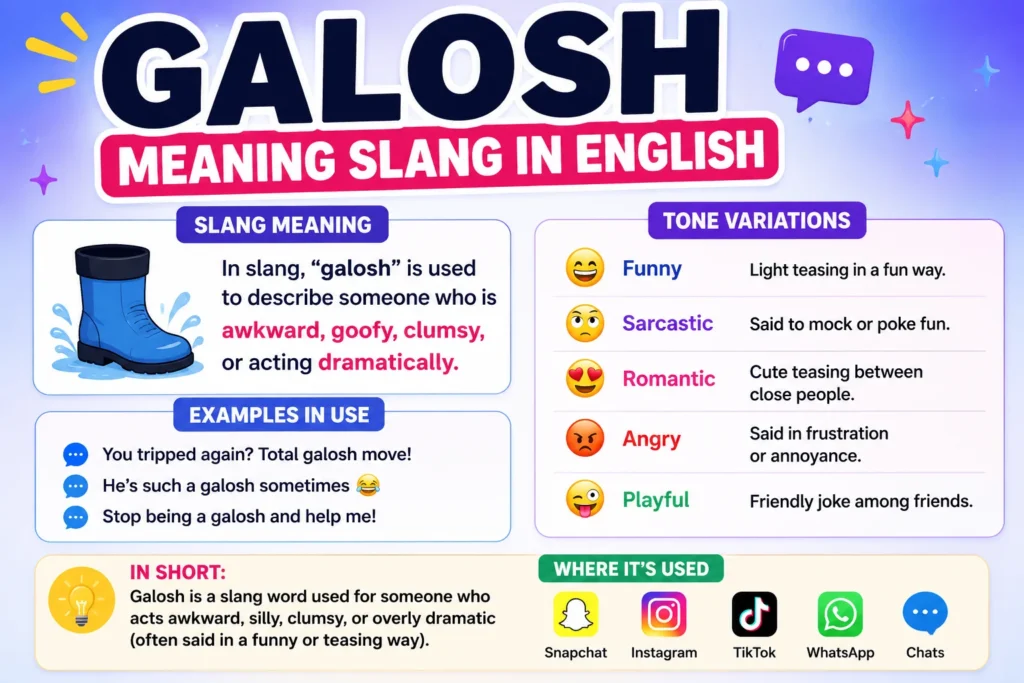

“Galosh” in slang usually refers to someone acting awkward, goofy, clumsy, or oddly dramatic online. While the original English word means a waterproof boot, internet users sometimes use it humorously as a playful insult or meme-style nickname in chats and social media.
People search for the galosh meaning slang in English because the word appears in memes, TikTok comments, gaming chats, and random online conversations where it clearly does not mean footwear. The confusion happens because “galosh” has a standard dictionary meaning, but online users sometimes turn unusual words into sarcastic or funny slang terms.
In digital communication, slang evolves quickly. A random word can suddenly become part of Gen Z vocabulary simply because it sounds funny, expressive, or meme-worthy. That is exactly why terms like “galosh” occasionally trend in casual chat phrases on TikTok, Snapchat, Instagram, and Discord.
Meaning & Explanation
Galosh Meaning Slang in English Meaning in Text
In texting culture, “galosh” is usually used jokingly to describe:
- Someone being awkward
- A goofy or clueless person
- Someone acting extra dramatic
- A person doing something embarrassing
Example:
“Bro slipped during the livestream like a total galosh.”
Here, the word is not serious. It is playful internet slang used to tease someone lightly.
Galosh Meaning Slang Slang Meaning
The galosh meaning slang usage is not officially recognized in dictionaries yet, but online communities sometimes use it creatively. Like many internet slang terms, the meaning depends heavily on context and tone.
Possible slang meanings include:
- Silly person
- Clumsy individual
- Meme character energy
- Weird but funny friend
- Someone socially awkward
This is common in meme culture where random words gain new meanings.
What Does Galosh Meaning Slang in English Mean in Chat?
In chat conversations, “galosh” often appears as:
- A teasing nickname
- A sarcastic reaction
- A funny insult between friends
- A playful response to awkward behavior
For example:
A: “I accidentally liked her 2021 photo.”
B: “You absolute galosh.”
In this context, it means “awkward person” or “goofball.”
Galosh Meaning Slang in English Meaning on Snapchat
On Snapchat, slang spreads quickly through streaks, captions, and private chats. “Galosh” may appear in:
- Funny selfie captions
- Group chat jokes
- Snaps showing embarrassing moments
- Meme screenshots
Example caption:
“Dropped my drink again… certified galosh moment.”
Galosh Meaning Slang in English Meaning on Instagram, TikTok, WhatsApp
On Instagram, people may use “galosh” in comments or memes to mock funny behavior in a harmless way.
TikTok
TikTok users often invent random slang for comedic effect. “Galosh” fits the trend because it sounds dramatic and unusual.
On WhatsApp, friends may use it casually in group chats as a nickname or joke.
Example:
“Don’t invite Jake to bowling again. He’s a galosh.”
Is “Galosh” an Acronym, Short Form, or Typo?
“Galosh” is:
- Not an acronym
- Not a texting abbreviation
- Not a short form
- Not a phonetic spelling
It is actually a real English word that internet users have repurposed into humorous slang.
This happens often online. Words gain new meanings simply because users find them funny or expressive.
Tone & Context Variations
The meaning of “galosh” changes depending on tone and situation.
Funny Tone
In funny conversations, “galosh” sounds harmless and playful.
A: “I walked into the wrong classroom.”
B: “You’re such a galosh.”
A: “Honestly accurate.”
Sarcastic Tone
Sometimes it carries mild sarcasm.
A: “I forgot my wallet again.”
B: “Classic galosh behavior.”
The tone is teasing, not aggressive.
Romantic Tone
Occasionally couples use it jokingly.
A: “You wore mismatched shoes on our date.”
B: “Don’t expose me.”
A: “My adorable galosh.”
Here it becomes affectionate teasing.
Angry Tone
In heated conversations, it may sound more insulting.
A: “You ruined the whole plan.”
B: “Stop acting like a galosh.”
The word becomes sharper depending on delivery.
Playful Tone
This is the most common usage online.
A: “I tripped on air.”
B: “Peak galosh energy.”
It feels meme-like and lighthearted.
Real Chat Examples (Natural & Relatable)
Example 1
A: “I sent the text to my boss instead of my friend.”
B: “You galosh.”
A: “I’m never recovering.”
Example 2
A: “I waved back at someone who wasn’t waving at me.”
B: “That’s painfully galosh.”
Example 3
A: “I burned instant noodles.”
B: “Only a galosh could do that.”
Example 4
A: “Why did you run into the glass door?”
B: “It looked open!”
Example 5
A: “I forgot my own birthday password.”
B: “Certified galosh moment.”
Example 6
A: “I wore slippers to school accidentally.”
B: “You absolute galosh.”
Example 7
A: “I liked my own post.”
B: “Galosh behavior detected.”
Example 8
A: “I laughed during the serious meeting.”
B: “You’re impossible.”
Example 9
A: “I spilled coffee on my laptop.”
B: “You’re living the galosh lifestyle.”
Example 10
A: “I got lost using Google Maps.”
B: “That’s impressive.”
Example 11
A: “I forgot why I entered the room.”
B: “Galosh brain activated.”
Example 12
A: “I called my teacher mom.”
B: “No coming back from that.”
Example 13
A: “I dropped my fries upside down.”
B: “Galosh curse strikes again.”
Example 14
A: “I locked myself outside twice today.”
B: “You need supervision.”
Example 15
A: “I practiced my speech in the wrong classroom.”
B: “Legendary galosh moment.”
Grammar & Language Role
What Part of Speech Is “Galosh” in Slang?
In slang, “galosh” usually acts as:
- A noun
- A nickname
- A descriptive label
Example:
“You’re a galosh.”
Sentence Position
It commonly appears:
- At the end of a sentence
- As a direct label
- As a reaction phrase
Examples:
- “Don’t be a galosh.”
- “That was galosh behavior.”
Does It Replace a Full Sentence?
Sometimes yes.
Example:
A: “I sent the wrong screenshot.”
B: “Galosh.”
One word communicates teasing disappointment.
Tone Impact
The tone can sound:
- Funny
- Mocking
- Playful
- Sarcastic
The relationship between speakers matters a lot.
Formal vs Informal Use
“Galosh” slang is highly informal.
Avoid using it in:
- Professional emails
- School essays
- Workplace communication
It belongs mostly in casual digital communication.
How to Reply When Someone Says Galosh Meaning Slang in English
Funny Reply
- “I accept my destiny.”
- “Professional galosh here.”
- “That’s my brand now.”
Serious Reply
- “Okay, fair point.”
- “I really messed up.”
- “I know that looked bad.”
Flirty Reply
- “But I’m your favorite galosh.”
- “You still like me though.”
- “Cute galosh energy?”
Neutral Reply
- “Lol maybe.”
- “That’s fair.”
- “Honestly true.”
Comparison Table
| Slang Term | Meaning | Usage Context | Tone | Popularity | Confusion Risk |
|---|---|---|---|---|---|
| Galosh | Awkward or goofy person | Memes, chats | Playful | Medium | High |
| Goober | Silly person | Friendly teasing | Funny | High | Low |
| Clown | Someone embarrassing themselves | Social media | Sarcastic | Very High | Medium |
| NPC | Person acting robotic | Gaming/TikTok | Mocking | Very High | Medium |
| Dork | Socially awkward person | Casual conversation | Lighthearted | High | Low |
| Genius | Opposite sarcastic meaning | Irony | Sarcastic | High | Medium |
Who Uses This Term?
Age Group
Most users are:
- Teenagers
- Young adults
- Meme-focused internet users
Gen Z vs Millennials
Gen Z is more likely to use random meme slang like “galosh.”
Millennials may recognize it less often unless active on TikTok or gaming platforms.
Region
The term appears mostly in:
- US internet culture
- English-speaking meme communities
- Global TikTok humor
Platforms Where It Is Most Common
- TikTok
- Snapchat
- Discord
- Gaming chats
- Group messages
Origin & Internet Culture Insight
Possible Origin
Originally, “galosh” means a waterproof overshoe. The slang version likely developed because:
- The word sounds funny
- It has exaggerated energy
- Internet users enjoy random vocabulary humor
TikTok Influence
TikTok encourages absurd humor. Random words often become viral slang because creators use them repeatedly in funny contexts.
Meme Culture Role
Modern meme culture frequently turns ordinary words into ironic jokes.
Words become funny because:
- They sound dramatic
- They feel old-fashioned
- They create absurd contrast
“Galosh” fits perfectly into this pattern.
Fast Typing Culture
Internet slang evolves quickly because users prefer:
- Fast reactions
- Expressive terms
- Short humorous labels
Why People Say Galosh Meaning Slang in English on TikTok
TikTok users often use “galosh” because it feels:
- Random
- Unexpected
- Meme-worthy
- Slightly absurd
That randomness is exactly why it becomes funny.
Safety & Appropriateness
Is It Rude?
Usually no.
“Galosh” is generally playful and mild.
Is It a Bad Word?
No, it is not profanity.
However, tone matters. Repeatedly calling someone a galosh aggressively could sound insulting.
Should You Use It in School or Office?
Casually with friends? Probably fine.
In professional settings? Better avoided.
It is still internet slang and may confuse people unfamiliar with meme culture.
Experience-Based Insight
In real online conversations, “galosh” is mostly used ironically among friends. It rarely appears as a serious insult. Instead, people use it to react to awkward moments, clumsy mistakes, or chaotic behavior in a funny way.
The term works because it sounds naturally goofy. Much like words such as “goober” or “clown,” its humor comes from delivery rather than dictionary definition.
FAQ
What Does Galosh Meaning Slang in English Mean in Text?
In text slang, “galosh” usually means a goofy, awkward, or clumsy person being teased playfully online.
Is Galosh Slang Rude?
Not usually. It is generally mild and humorous unless used aggressively.
What Does Galosh Meaning Slang in English Mean on Snapchat?
On Snapchat, it often refers to embarrassing or funny behavior shared in chats or stories.
Is Galosh the Same as IDK?
No. “IDK” means “I don’t know,” while “galosh” is a playful slang label for awkward behavior.
Can Adults Use Galosh Meaning Slang in English?
Yes. Anyone can use it casually, though it is more common among younger internet users.
How Do You Respond to Galosh Meaning Slang in English?
You can respond humorously, casually, or sarcastically depending on the conversation tone.
Is Galosh a Real English Word?
Yes. Traditionally, a galosh is a waterproof shoe covering or boot.
Why Is Galosh Trending Online?
The word became popular because meme culture often turns random words into funny internet slang.
Does Galosh Mean Dumb?
Not exactly. It usually means awkward, goofy, or clumsy rather than unintelligent.
Is Galosh Used on TikTok?
Yes, especially in meme captions and ironic comments.
Can Galosh Be a Compliment?
Sometimes jokingly among close friends.
Is Galosh Gen Z Slang?
Mostly yes. It fits modern Gen Z internet humor.
Why Do Random Words Become Slang?
Internet culture loves absurd humor and creative language evolution.
Conclusion
The galosh meaning slang in English has evolved far beyond its original dictionary definition. Online, it usually describes someone being awkward, goofy, chaotic, or hilariously clumsy in a playful way.
Because internet slang changes rapidly, words like “galosh” can suddenly gain popularity through TikTok trends, meme culture, and casual digital communication.
Usage Tips
- Use it casually with friends
- Keep the tone playful
- Avoid using it aggressively
- Best for memes and relaxed chats
Common Mistakes
- Thinking it is an official acronym
- Using it formally
- Assuming everyone knows the slang meaning
When to Use and When to Avoid
Use it:
- In casual conversations
- On social media
- In humorous chats
Avoid it:
- In professional settings
- During serious discussions
- Around people unfamiliar with internet slang